
AN: This is Part 1 of an ongoing series where I share what I’m learning about self-marketing on my personal journey. These are just honest field notes.
Estimated reading time: 6-8 minutes
Marketing doesn’t suck.
No, really.
Don’t believe me? I can’t say that I blame you. I’ve avoided marketing my entire adult life. Perhaps prior to that as well.
Let me clarify—that’s marketing of myself. I’m all over supporting others and helping them succeed, whether it’s a product, a service, or a friend whom I wholeheartedly believe in. Me? I’ve done my utmost to avoid and make excuses for why NOT to market myself.
My favorite excuses come in flavors of humility or shyness. A lack of desire to be the center of attention. I’ve even used the money excuse. That’s a lot of dodging the problem and avoiding a real solution, never moving beyond the status quo. Win/win? More like lose/lose.
It took a fair bit of soul-searching and self-awareness, but I recognized my familiar pattern of avoidance. I could only claim obliviousness for so long. My conscience, aka The Husband, happily pointed it out to me as well.
Book Marketing Is Not Rocket Science
I’m of the opinion that most people can learn something given enough time and effort. I know it’s hyperbole, but you can learn Rocket Science. It just takes a lot more time and effort, along with a few unnamed qualities. On a scale of doing nothing versus learning Rocket Science, Marketing sits primly in the first span of that scale. You have to actually do something, but it’s unlikely you’ll need to understand thermodynamics.
Marketing is another iterative process. It reminds me of user experience design, in particular, usability testing. You research and identify who you think your audience is, and, based on that, create a persona (a simplified approximation of your typical reader). Then you figure out their flow for choosing a book like yours, such as what imagery they expect on the cover, keywords that will light them up, where they’re likely to acquire your book, and what’s a reasonable and expected cost for your genre.
The key is that it’s a defined process. When I say ‘iterative’, I mean a process that you can repeat, across the board, and adjust based on the results that you do or don’t get.
Processes are good. They bring predictability and stability. It also means there’s an existing path you can follow for bare-bones marketing.
I’m not denigrating those who’ve mastered the science and art of marketing. To you, I bow low, as now I’m in a game of catch-up, and the stakes have never been more personal. Marketing is a learned skill, just like any other. It takes knowledge, experience, and continuous learning to get halfway decent at it.
But again, here’s the kicker—you have to actually try. No half-assing and expecting miraculous results. Been there. Done that. Have the low sales to prove it.
Because I’d like to see people succeed where I failed, I’m more than happy to share those baby steps I took to move past my self-marketing block. You’re worth it, so here’s the first concrete step I took.
Baby Step 1: Market, Because You’re Worth It
“It takes courage to grow up and become who you really are.” — E.E. Cummings
Let’s start with Step 1 of “Why Marketing Doesn’t Suck.”
Repeat after me, I’m worth it.
Yup.
That’s the first layer of the wall that needs to come down. Insecurity is a brutal beast. Pride in who you are and what you are capable of doesn’t necessarily make you prideful. There’s nothing wrong with being proud of what you create. That’s not ego, it’s self-confidence, wrapped in honesty. Believe in yourself.
I had a brief dalliance with a personal coach that resulted in a different kind of therapy than I’d experienced. What this wonderful woman helped me to understand, through many sessions, is that we should celebrate the things we’re proud of. Regardless of internal reservations, there’s a rightness in being kind to yourself. It’s also a joy that can and should be shared with others.
Think of all the amazing and unique experiences every individual has. The number of times I’ve seen, heard, or read about something someone else has created or lived through and been immediately inspired by it is countless. Infinite.
So, play it forward. Share what you’ve done, what you do, with others. There’s no shame in being proud of yourself and the little breadcrumbs you leave behind on your journey through this life. How others react is completely up to them and not a reflection of me or you.
Put yourself out there and take the risk. Rejection is awful and completely possible. But there’s always the chance that someone will witness your creation and, for that brief time, you share a bond. You both appreciate the same, unique quality regardless of your separate selves. That won’t happen if you never accept the risk. The only way anything you do will travel beyond your inner circle (and I have a very small inner circle—super introvert here), is to reach out, over and beyond your wall. And yes, that’s Step 2 of this process.
Baby Step 2: Hello World in Marketing Terms
I focused my efforts on Amazon, as that’s where I’m selling primarily right now. There’s a wealth of data around how readers find their next book on Amazon, and not only in general, nebulous terms. A quick search, some detailed discussion with Claude.ai, and a few articles later, I understood at a high-level Amazon’s built-in marketing options.
My first baby step was very simple, especially since I was using Amazon’s free self-publishing platform, KDP (Kindle Direct Publishing), to handle the printing and distribution of my books. I opted to enroll my book in Amazon’s KDP Select. It was a super simple click-and-submit. It took me a handful of minutes to do, most of which was spent hemming and hawing. Then I took a breath, and it was done.
And that was it. Low energy and easy to do. All it required of me was a commitment to distribute the eBook of Zombie Girl Omega exclusively through Amazon Kindle for 90 days. As I had already decided to focus on Amazon as my distributor, this was a straightforward decision.
With that first hurdle cleared without nuclear fallout, I got a little more adventurous and took a long, deep look into Amazon’s full suite of marketing options.
Baby Step 3: Familiarize Yourself with Amazon Marketing Options
There is a grand total of 6 marketing options in Amazon KDP that I’ve discovered thus far (There could be more, but this is where Amazon’s user-friendly design falls flat—like… one-dimensional flat—I digress.). They range in complexity and out-of-pocket costs. Think of these as stairs—each step requiring a little more commitment than the last.
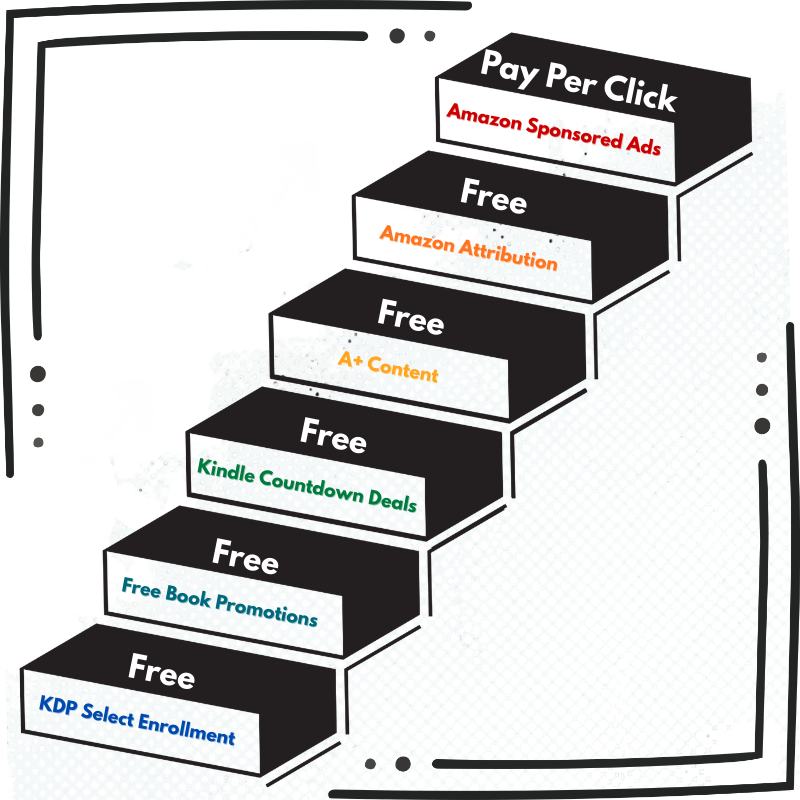
They’re in order from easiest/simplest to hardest (in my humble opinion). I’ve also included the high-level benefits and drawbacks of using each method.
- KDP Select Enrollment — Super easy: just check a box, and you agree to a 90-day Kindle exclusivity period. This allows you to use two exclusive, free marketing features on Amazon. Plus, you get eligibility for Kindle Unlimited and the Kindle Owners’ Lending Library. The decision is the hard part, as there is a tradeoff with the exclusivity aspect.
- Benefits: Unlocks Free Book Promos and Countdown Deals, earns page-read royalties through Kindle Unlimited, and certain genres like sci-fi and fantasy read heavily in KU.
- Drawbacks: Exclusivity means no selling on Kobo, Apple Books, Barnes & Noble, etc., or direct. This is a significant opportunity cost if you’re working toward wider distribution than Amazon.
- Free Book Promotions — This is one of the two exclusive marketing add-ons you get with KDP Select. Flip a switch in the KDP dashboard, set your dates, and done. The main “skill” is timing it strategically.
- Benefits: Spikes download numbers fast, boosts visibility in free charts, is great for launching a series by giving Book 1 away, and builds readership with low friction.
- Drawbacks: Zero royalty during free days, downloaded-but-never-read copies don’t help engagement metrics, and the visibility boost fades quickly without a follow-up strategy.
- Kindle Countdown Deals — This is the second KDP Select bonus feature and is nearly as simple as Free Promos, but you need to understand the pricing window rules (the book must be at full price for 30 days prior) to avoid getting tripped up.
- Benefits: Maintains your royalty rate, and the visible price drop creates urgency. It pairs well with newsletter promotions like Bargain Booksy or Fussy Librarian.
- Drawbacks: Requires a 30-day full-price lock before and after, is limited to KDP Select titles, and the discount window is short, so timing with external promotions is critical.
- A+ Content — Amazon provides templates, so it’s fairly guided. The challenge is writing and designing compelling content, which takes some creative effort but no technical knowledge. As I don’t have a spare research assistant or copywriter, I’ve found that bouncing ideas off Claude.ai can help tighten and optimize content.
- Benefits: Improves product page conversion rates, lets you showcase series order, build brand identity, and add visual storytelling that plain text can’t. Completely free.
- Drawbacks: Doesn’t drive traffic on its own—it only converts traffic you’re already getting. Time investment with no direct, visible payoff.
- Amazon Attribution — Setting up the tracking links is straightforward, but interpreting the data and acting on it meaningfully has a learning curve.
- Benefits: Tells you which external marketing channels are actually driving Amazon sales, so you can stop guessing and spend smarter. Especially valuable when you pair it with promotions through external campaigns (outside of Amazon).
- Drawbacks: Only tracks Amazon conversions, so it gives an incomplete picture of your broader marketing ecosystem. You have to already be running external campaigns to get value from it.
- Amazon Sponsored Ads (PPC) — The most complex option. You’ll need to do keyword research, come up with a bid strategy and campaign structure, do ACoS (Advertising Cost of Sales) management, and ongoing optimization to ensure it’s working for you. It’s easy to waste money fast on these without some foundational knowledge. That being said, there are tiers of complexity within Sponsored Ads. The simplest being an “Automatic Targeting” strategy.
- Benefits: Scalable, always-on visibility, highly targetable by keyword or competing product, and the only tool here that actively generates discovery rather than converting existing interested buyers.
- Drawbacks: Costs money with no guaranteed return, requires ongoing management and optimization, steep learning curve, and is easy to run at a loss.
The easiest Amazon marketing options tend to be reactive. In other words, they convert or temporarily boost existing interest. The hardest tool—PPC—is the only one that proactively enables and builds new audience discovery. A well-rounded marketing strategy eventually needs both ends of this spectrum working together. You need to acquire new readers, but you also need to continue to engage existing readers.
After the Baby Steps
Marketing may not suck, but it’s also not a walk in the park. Avoiding marketing gained me nothing more than excuses and dismal online sales. Could I have done things better when I launched my first (hell, second) book? Of course! But sometimes things have to suck before you are motivated to make them better.
Since I first delved into Amazon’s KDP marketing tools, I have learned more than I would have expected. I will say KDP’s tools could be far more intuitive, but I’ll harangue about that in another blog post. My Kindle Select enrollment has proven beneficial thus far. I’ve received a decent return from Kindle Unlimited pages read, and I plan to use both the Free Promo and Kindle Countdown in April, in concert, as Book 3 of Zombie Girl Omega gears up for launch in late April 2026.
Is it the Ultimate Marketing Strategy? Oh, heck no. However, I’m learning and getting a little better every time. Notice that this blog is titled Self-Marketing Doesn’t Suck Part 1? Yes, that’s because there is plenty to cover, and I’d rather not info-dump all that I’ve discovered about self-marketing in a single blog.
There’s more to share, and that’s best done in little bite-sized snacks versus a multi-course meal.
Listening to on Spotify: Wicked Games by Raign
Chain Reading: Eon by Greg Bear, Heart-Shaped Box by Joe Hill, The 5-Minute Stoic: Ancient Wisdom and Modern Habits to Calm Your Mind… by Shyann Cooper
Writing Nook: Children of Eden (first draft)
Latest Run: 19 miles